
Edwards County Court Records After a Jail Arrest
After someone is arrested and booked into Edwards County Jail, the custody question usually starts with the Edwards County Sheriff's Office. The court-record question starts when the charging office files a complaint, information, citation, or other charging document with the Kansas district court system. Edwards County uses a County Attorney rather than a separate district attorney office. The official County Attorney contact is Mark Frame at 500 Marsh Ave., Kinsley, KS 67547, phone (620) 659-3002, fax (620) 659-2583, and email mark@framelawllc.com.
The arrest and booking side should be checked through jail inmate records, the sheriff, or Kansas VINE when the question is current custody. Booking photographs and local mugshot availability belong with jail mugshots. The court record is different: it follows the filed case and may show the case number, defendant name, filing date, charges, statute references, hearings, bond orders, warrants, plea, disposition, sentence, and docket events.
The official County Attorney page explains that the office prosecutes or defends civil and criminal suits in which the state or county is a party or interested. That role makes the County Attorney the local charging contact for many state criminal cases after an Edwards County arrest, while Kansas CaseSearch and the Edwards County District Court clerk are the practical public-record routes for the docket itself.
The Edwards County Attorney's official page is a useful source for the local charging office and contact block: Edwards County Attorney.
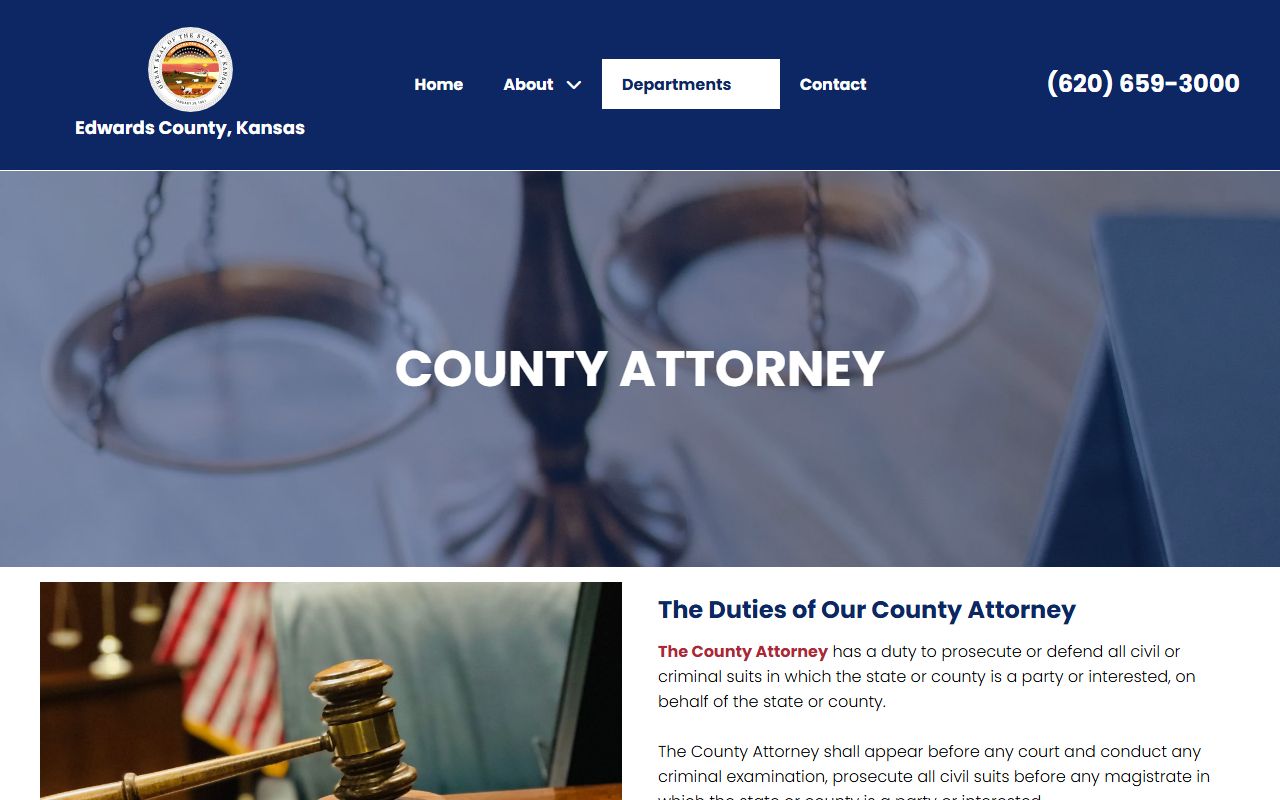
Use that office for prosecution-contact context, but use the court clerk or CaseSearch for public docket records and filed charge status.
How to Find Edwards County Court Records After an Arrest
Kansas CaseSearch is the official statewide portal to begin searching district court case information after an Edwards County arrest. The research capture confirms search criteria for case number, party name, business name, citation, and other role-based criteria. If a case has not appeared online yet, or if access is limited by the portal, contact Edwards County District Court at the courthouse.
- Open Kansas CaseSearch and choose the search criterion that fits what is known.
- Search by defendant party name first if the case number is unknown.
- Use a citation search when the arrest began from a traffic or citation-based offense.
- Open the matching case and read each charge, hearing entry, warrant event, bond order, and disposition separately.
The Kansas CaseSearch portal is the statewide starting point for filed district court cases: Kansas CaseSearch.
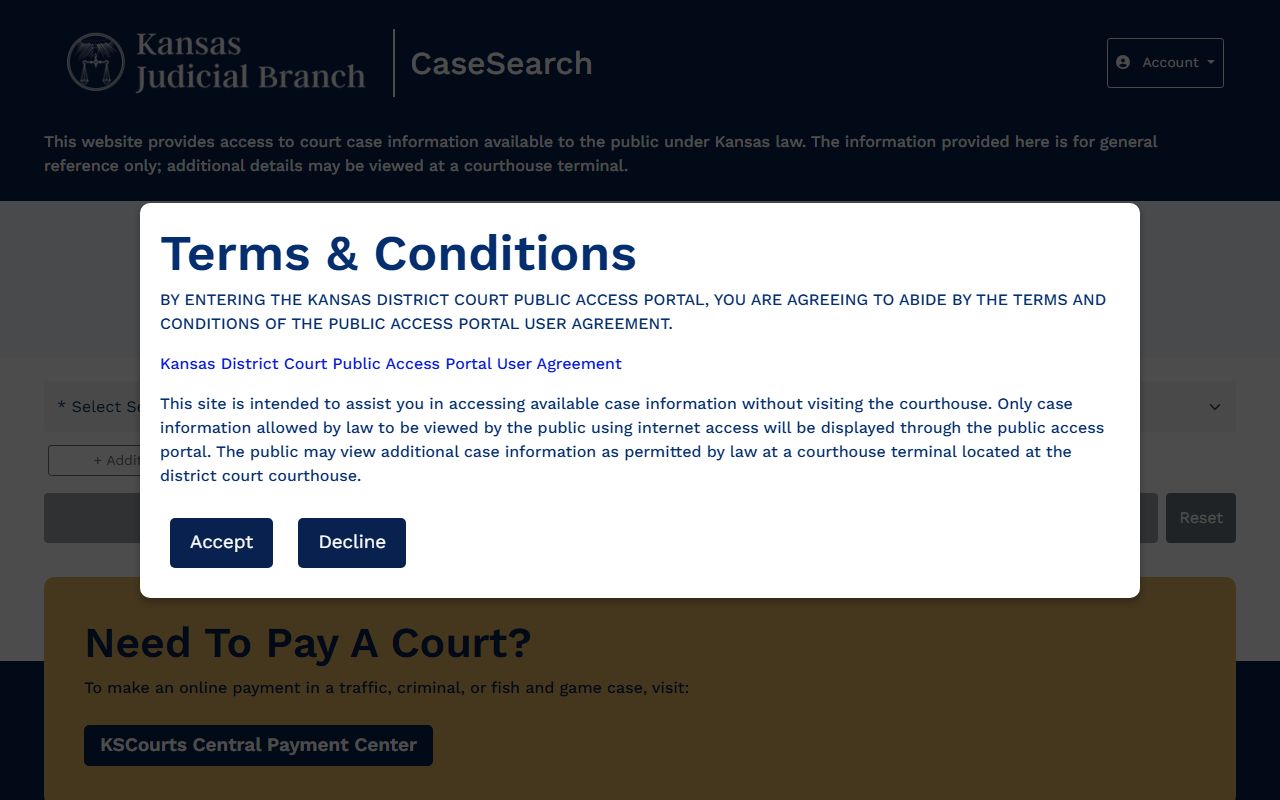
The screenshot source supports using CaseSearch for the court side of the lookup, not as a substitute for a current jail roster or sheriff custody confirmation.
| CaseSearch Field | Use It When | Notes |
|---|---|---|
| Case number | The docket number is already known. | Best for returning to the exact filed case. |
| Party name | Only the defendant's name is known. | Check spelling, middle names, and date context before assuming a match. |
| Business name | The party is an entity. | Less common for a jail-arrest pathway but available in the portal. |
| Citation | The incident began with a citation. | Useful for traffic or citation-based criminal matters. |
| Role-based criteria | The portal offers criteria tied to the user's access role. | Available options can vary by user role and court-access limits. |
Edwards County District Court Records After Arrest
When CaseSearch does not answer the question, use the local court. Edwards County Courthouse is listed by the Kansas courts system at 312 Massachusetts, PO Box 232, Kinsley, KS 67547. Posted hours are 8 a.m. to noon and 1 p.m. to 5 p.m. The court clerk can explain public access to the court file, but staff cannot act as a private attorney or predict the outcome of charges.
The official Kansas courts source for the local courthouse is Edwards County Courthouse.
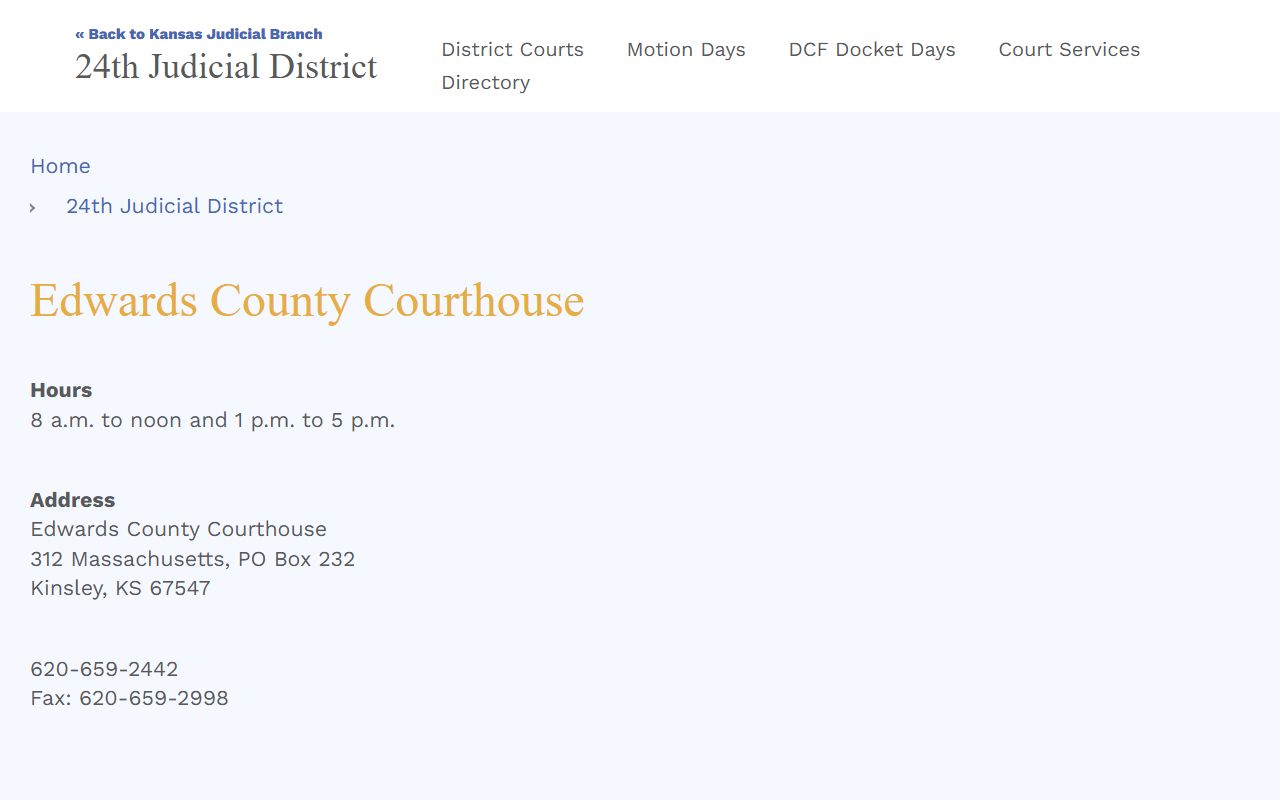
The courthouse page is the local fallback when an online court record is delayed, incomplete, or not visible through public CaseSearch access.
Charging Documents After a Jail Arrest
The path from arrest to court records is not automatic conviction language. Booking happens first at the jail. The charge record begins when the prosecutor files the document that tells the court what offense is being alleged. In Kansas practice, the public docket may show the charging document, amended filings, hearing settings, and disposition events as the case moves forward.
| Complaint | Information | Indictment | |
|---|---|---|---|
| Filed By | Usually a prosecutor, sometimes tied to officer-supported allegations. | Prosecutor. | Grand jury. |
| Common For | Many criminal cases, including misdemeanor and initial felony filings. | Felony prosecution after required preliminary steps. | Serious or grand-jury-presented matters. |
| Record Function | Starts or frames the case allegations. | States formal charges for prosecution. | Charges returned by a grand jury. |
Charge Status in Court Records After an Arrest
Charges may change after booking. A jail entry may reflect the arresting officer's initial allegation, while the court record reflects what the County Attorney files and what the judge later orders. Treat every count separately because one charge can be dismissed while another remains pending, is amended, or ends in a plea or conviction.
| Status | What It Means |
|---|---|
| Pending | The charge is still active and has not reached final disposition. |
| Amended / Reduced | The filed allegation changed, often to a different level, statute, or count after review or negotiation. |
| Dismissed | The court record shows the count was ended without a conviction on that count. |
| Nolle Prosequi | The prosecutor declined to continue prosecuting that count, subject to the exact docket entry and court order. |
| Disposed | The count has an outcome, such as plea, trial result, dismissal, diversion, or sentencing entry. |
Bond and Release After an Arrest
No Edwards County bond-payment portal or local bond instruction page was located in the official research. The practical route is to call the Edwards County Sheriff's Office and ask whether bond is set, the exact amount, whether the bond is cash-only or surety, where payment is accepted, and whether another hold blocks release. Bond affects custody, but it does not erase or finish the court case.
| Bond Type | How It Works |
|---|---|
| Cash Bond | The full amount is paid as directed by the court or jail. |
| Surety Bond | A commercial bondsman posts bond when accepted under the court's order. |
| PR / Own Recognizance | The person signs a promise to appear and follows release conditions instead of posting full cash. |
| No-Bond Hold | Release is not available until a judge changes the order or a separate hold clears. |
Warrants That Lead to an Arrest
No official Edwards County active warrant search page was located. The sheriff's office does handle civil process duties, including warrants and other legal documents, so warrant questions should start with the sheriff when public confirmation is available. Bench warrants tied to filed district court cases may also appear through Kansas CaseSearch or the Edwards County District Court clerk. Municipal warrants may be held by the city court involved, and federal warrants are separate from the county website.
Because warrant information can involve safety, investigative, or court-access limits, a public-record request may not return every detail. A person trying to resolve a warrant should confirm instructions directly with the issuing court or the sheriff before appearing in person.
Charges vs. Convictions
An Edwards County arrest charge is an accusation, not proof that the person was convicted. Court records after arrest should be read through the final disposition line for each count. A dismissed count, an amended count, a diversion, and a conviction have different meanings even when they came from the same booking event.
| Charge | Conviction | |
|---|---|---|
| Stage | Filed accusation after arrest or citation. | Final outcome after plea, trial, or other qualifying disposition. |
| Proof Level | Filed based on legal charging standards, not final proof. | Requires a guilty plea, finding, or verdict according to criminal procedure. |
| Public Record Use | Should be described as pending, dismissed, amended, or otherwise disposed. | May be described as a conviction only when the docket supports that result. |
Sealed vs. Expunged Arrest Records
Kansas expungement law matters when an arrest, charge, conviction, diversion, or related record later becomes eligible for restricted public access. Research identifies K.S.A. 21-6614 for eligible convictions, diversion agreements, and related arrest records, and K.S.A. 22-2410 for arrest-record expungement. Eligibility depends on the case result, waiting period, offense type, and court order.
| Sealed | Expunged | |
|---|---|---|
| Visibility | Public access is limited by court rule, statute, or order. | The record is restricted through an expungement order, with legal exceptions. |
| Law Enforcement Access | May remain available to authorized agencies or courts. | May still be available for certain law-enforcement, licensing, court, or statutory purposes. |
| Kansas Route | Depends on the record type and the reason public access is restricted. | Use K.S.A. 21-6614 or K.S.A. 22-2410 when the record fits those statutes. |
KBI Criminal History and Court Record Limits
Kansas.gov offers a Kansas Bureau of Investigation public criminal history record search for statewide background-record purposes. The research source lists a $30 name-based public search, requires a KanAccess login, and gives system availability from 4 a.m. to midnight Central. That search is not the same as reading the Edwards County court docket, and it is not a substitute for confirming current custody with the sheriff.
The official criminal history search source is Kansas criminal history record search.
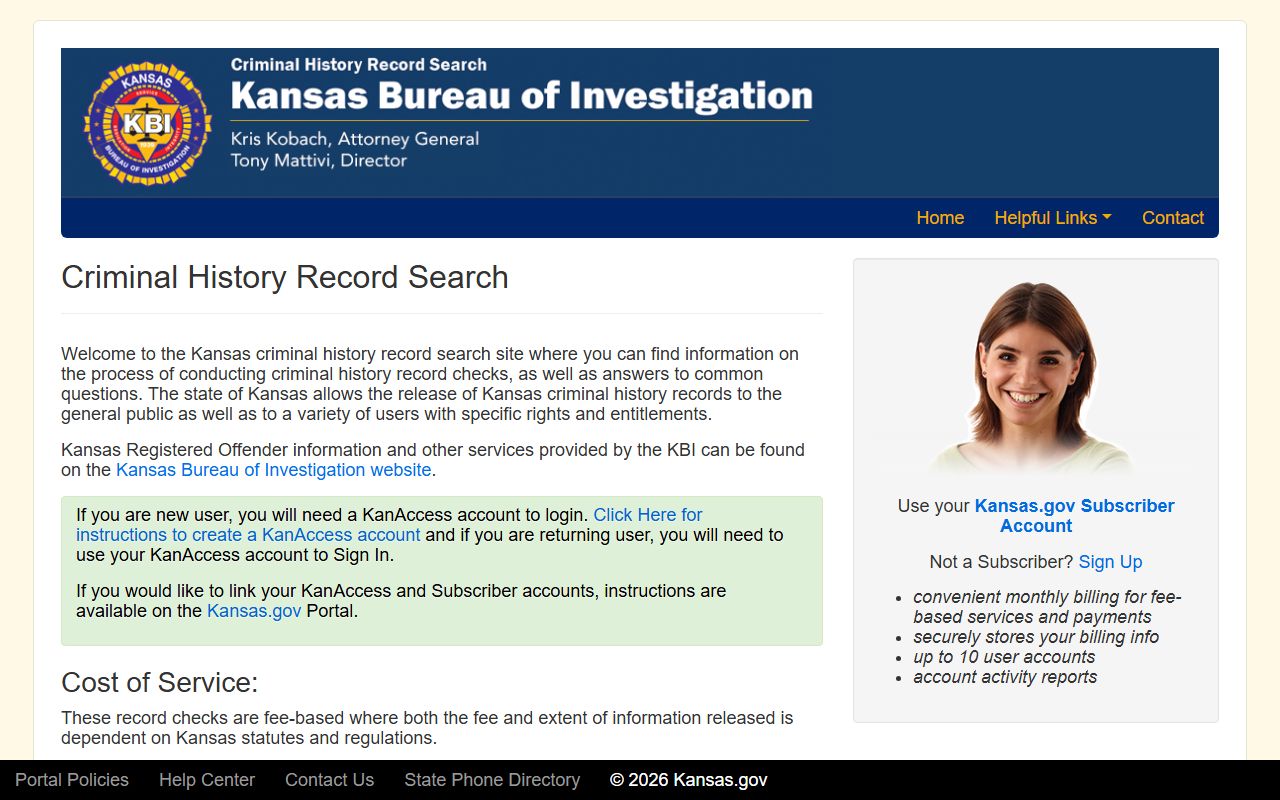
Use the KBI route when the need is a statewide criminal-history check, and use Kansas CaseSearch or the court clerk when the need is the public docket for a specific Edwards County case.
Important: This private site is not a consumer reporting agency and may not be used for FCRA-covered screening decisions.
Restricted Court Records After an Arrest in Edwards County
Kansas Open Records Act provisions affect what can be released. K.S.A. 45-220 addresses access procedures, copies, office hours, and custodian duties. K.S.A. 45-221 lists records that are not required to be disclosed, including categories relevant to criminal investigation records, privacy redactions, mugshots, and arrest reports. K.S.A. 45-222 and 45-223 address remedies, attorney fees, and civil penalties for violations, while K.S.A. 45-230 restricts unlawful use of names obtained from public records.
The Kansas Attorney General's KORA guidance says jail rosters and police blotters are open, but mugshots and standard arrest reports may be discretionarily closed. That distinction matters for Edwards County because no official online roster, booking report, active warrant page, or mugshot gallery was located. For records not visible online, make a focused request to the sheriff, County Attorney, or court custodian that actually holds the record.